
- alfredoginavernatyson
-
 Jumat, 13 Januari 2017
 -
 0 Comments


Download Artificial Intelligence: A Modern Approach (3rd Edition)
Artificial Intelligence: A Modern Approach (3rd Edition). Just what are you doing when having downtime? Talking or browsing? Why do not you aim to review some book? Why should be reviewing? Reading is among fun and enjoyable activity to do in your leisure. By checking out from several resources, you can discover brand-new info and also experience. Guides Artificial Intelligence: A Modern Approach (3rd Edition) to read will certainly be various starting from scientific books to the fiction e-books. It implies that you could review guides based upon the requirement that you wish to take. Of course, it will be different and you could review all e-book types at any time. As here, we will reveal you a book need to be read. This publication Artificial Intelligence: A Modern Approach (3rd Edition) is the selection.
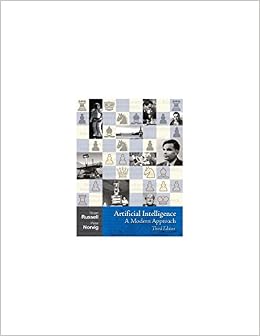
Artificial Intelligence: A Modern Approach (3rd Edition)

Download Artificial Intelligence: A Modern Approach (3rd Edition)
Inspect currently our new upgraded book collection in this site. As the one of the biggest as well as most finished site of soft file publications, we constantly restore the collections by upgrading guides. You can find some various titles daily that might associate with just what you are looking for now. One of one of the most provided as well as promoted book currently is the Artificial Intelligence: A Modern Approach (3rd Edition) This book is advertised for you who are actually like with the associated topic.
As one of the window to open up the new world, this Artificial Intelligence: A Modern Approach (3rd Edition) provides its incredible writing from the writer. Published in one of the preferred publishers, this book Artificial Intelligence: A Modern Approach (3rd Edition) turneds into one of the most wanted publications lately. In fact, the book will certainly not matter if that Artificial Intelligence: A Modern Approach (3rd Edition) is a best seller or not. Every publication will constantly offer ideal sources to obtain the viewers all finest.
Are you still perplexed why should be this book? After having wonderful work, you could not require something that is really hard. This is just what we state as the affordable book to review. It will not only give home entertainment for you. It will certainly offer life lesson behind the amusing features. From this case, it is undoubtedly that this book is appropriate for you and for all individuals that need straightforward and fun book to read.
You can quickly finish them to check out the web page and after that enjoy obtaining guide. Having the soft documents of this book is additionally good enough. By this way, you could not need to bring guide everywhere. You can conserve in some suitable tools. When you have actually made a decision to start checking out Artificial Intelligence: A Modern Approach (3rd Edition) again, you could start it all over and every time as soon as well done.
From the Back Cover
The long-anticipated revision of this #1 selling book offers the most comprehensive, state of the art introduction to the theory and practice of artificial intelligence for modern applications.Intelligent Agents. Solving Problems by Searching. Informed Search Methods. Game Playing. Agents that Reason Logically. First-order Logic. Building a Knowledge Base. Inference in First-Order Logic. Logical Reasoning Systems. Practical Planning. Planning and Acting. Uncertainty. Probabilistic Reasoning Systems. Making Simple Decisions. Making Complex Decisions. Learning from Observations. Learning with Neural Networks. Reinforcement Learning. Knowledge in Learning. Agents that Communicate. Practical Communication in English. Perception. Robotics.For computer professionals, linguists, and cognitive scientists interested in artificial intelligence.
Read more
About the Author
Stuart Russell was born in 1962 in Portsmouth, England. He received his B.A. with first-class honours in physics from Oxford University in 1982, and his Ph.D. in computer science from Stanford in 1986. He then joined the faculty of the University of California at Berkeley, where he is a professor of computer science, director of the Center for Intelligent Systems, and holder of the Smith–Zadeh Chair in Engineering. In 1990, he received the Presidential Young Investigator Award of the National Science Foundation, and in 1995 he was cowinner of the Computers and Thought Award. He was a 1996 Miller Professor of the University of California and was appointed to a Chancellor’s Professorship in 2000. In 1998, he gave the Forsythe Memorial Lectures at Stanford University. He is a Fellow and former Executive Council member of the American Association for Artificial Intelligence. He has published over 100 papers on a wide range of topics in artificial intelligence. His other books include The Use of Knowledge in Analogy and Induction and (with Eric Wefald) Do the Right Thing: Studies in Limited Rationality. Peter Norvig is currently Director of Research at Google, Inc., and was the director responsible for the core Web search algorithms from 2002 to 2005. He is a Fellow of the American Association for Artificial Intelligence and the Association for Computing Machinery. Previously, he was head of the Computational Sciences Division at NASA Ames Research Center, where he oversaw NASA’s research and development in artificial intelligence and robotics, and chief scientist at Junglee, where he helped develop one of the first Internet information extraction services. He received a B.S. in applied mathematics from Brown University and a Ph.D. in computer science from the University of California at Berkeley. He received the Distinguished Alumni and Engineering Innovation awards from Berkeley and the Exceptional Achievement Medal from NASA. He has been a professor at the University of Southern California and a research faculty member at Berkeley. His other books are Paradigms of AI Programming: Case Studies in Common Lisp and Verbmobil: A Translation System for Faceto-Face Dialog and Intelligent Help Systems for UNIX.
Read more
Product details
Hardcover: 1152 pages
Publisher: Pearson; 3 edition (December 11, 2009)
Language: English
ISBN-10: 0136042597
ISBN-13: 978-0136042594
Product Dimensions:
8.3 x 1.6 x 10.2 inches
Shipping Weight: 4.4 pounds (View shipping rates and policies)
Average Customer Review:
4.0 out of 5 stars
216 customer reviews
Amazon Best Sellers Rank:
#56,103 in Books (See Top 100 in Books)
Since this version of the book is for the Indian market, I was a bit worried about the potential differences from the U.S. 3rd edition. But after doing a first-hand comparison, I found a LOT more similarities than differences.The biggest difference is the absence of the last two chapters. The U.S. edition includes: Chapter 26, "Philosophical Foundations", which covers arguments over consciousness in machines and the possibility of robot uprisings; and Chapter 27, "AI: The Present and Future", which *briefly* describes some things AI researchers need to work on before we can build a "general-purpose intelligent agent" (a.k.a. one single AI that will be good enough at a lot of different tasks). These two chapters are interesting, but I wouldn't call them core material, so I'm not surprised they got left out.Other than that, the differences are astonishingly minor. The chapters are unnumbered, and some of them swapped places for no reason, but all the content from chapters 1 through 25 is here, plus the two appendixes. The ONLY edits to the text are removals of cross-chapter references. The U.S. version will say something like, "When we discussed whatzits in Chapter 4, we mentioned that they come in two flavors, X and Y", while the same line in this book will say, "Whatzits come in two flavors, X and Y". Again, those are the ONLY edits. All the other sentences are the same. The equations are the same. The diagrams are the same. The exercises at the end of each chapter are the same.In short, if you can do without those last two chapters, buy this version and save your money.
When this book first arrived, I had a lot of buyer's remorse. I wanted something to read on the side, not as a textbook for a class I'm taking or anything like that. I wasn't expecting it to be this big. How could I possibly read all this?However, it's big for a reason. This book is filled with every possible thing you might want to know in the field of AI. It is all-encompassing from what I've seen. It also explains things very well in my opinion. Things are clear. You can clearly go through it, and although the math might need some note-taking, the book generally makes it easy for you to understand with examples. If you want to start delving into AI, machine learning, etc, but feel daunted about all the different crazy terms they use (adverserial networks, loss functions, overfitting, etc.), this is a good book to introduce to all this. It certainly did for me (Chapter 18: Machine Learning)
- Not the original version- Missing many chapters- Many blank pages- Order jumbled up , so you can't read in sequence
This is indeed one of the best books on Artificial Intelligence (AI). It is comprehensive in that in its 1,145 pages it covers and effectively explains concepts and practices; It is authorative as it is written and edited by some people who are pioneers in AI especially Peter Norvig; Being the 3rd edition it clearly updates and augments another 20% to the 80% of the 2nd edition with updates.With the massive number of reviewers and contributors, the book presents a balanced, realistic, and and down-to-earth understanding.The biggest attraction of this book, unlike many other books on this subject is that: 1. It avoids hype but humbling explaining things, and 2. It does not force you to understand things by referring you to some code fragment that is difficult to understand or execute.I liked the fact that this book has a nice and logical organization. Contents: I. Artificial Intelligence, II. Problem Solving, III Konwledge, Reasoning, and Planning, IV. Uncertain Knowlege and Reasoning, V. Learning, VI. Communicating, Presenting, and Acting, VII. Conclusion.Excellent work!
Horrible printing, like from a decades-old copy machine -- many missing and blotched parts of the text. Super-cheap paper.
Great content, but terrible job done by publisher. Binding is so poor that pages come tearing apart while you're reading or normally making notes/ underlines.
This is the best introductory review to Artificial Intelligence on the market. It's very well written and organized. There are other books that are better for focusing on one particular aspect of AI, but as a general book this is the best I've seen. If you are looking for a really good introductory textbook to AI that does not completely dumb things down, buy this book.Most of the negative comments about this book come from people stating that it's not a big enough update from the prior edition. While it's true that the entire field of AI has not been completely updated since the last edition, it's also not the case that this book comes out with new editions with the frequency of some Calculus or Economics textbooks where new editions seem to come out purely to ensure students can't buy a used book for the course. The updates are substantial. Whether the new edition gives you enough extra to want to buy it if you own the old edition is a decision only you can make for yourself after spending some time at the website for the book aima.cs.uberkeley.edu.The Kindle conversion of this book is absolutely horrendous. I prefer to buy electronic copies of books if possible so I don't have to carry a heavy hard copy around since I often read while commuting. I would not recommend that for this book, even though at a 1000+ textbook sized pages, it is a pretty substantial book. Fortunately a friend of mine had bought a Kindle copy of the book and I was able to see how bad it was and I bought the hard copy.I recently got an email telling me Amazon was sending out an updated version of the Kindle version of Steve Job's biography because the conversion hadn't been done properly. They really need to do that for this book. Once done it may be a good idea to state on the website that the Kindle conversion has been fixed.
Artificial Intelligence: A Modern Approach (3rd Edition) PDF
Artificial Intelligence: A Modern Approach (3rd Edition) EPub
Artificial Intelligence: A Modern Approach (3rd Edition) Doc
Artificial Intelligence: A Modern Approach (3rd Edition) iBooks
Artificial Intelligence: A Modern Approach (3rd Edition) rtf
Artificial Intelligence: A Modern Approach (3rd Edition) Mobipocket
Artificial Intelligence: A Modern Approach (3rd Edition) Kindle


0 komentar: